
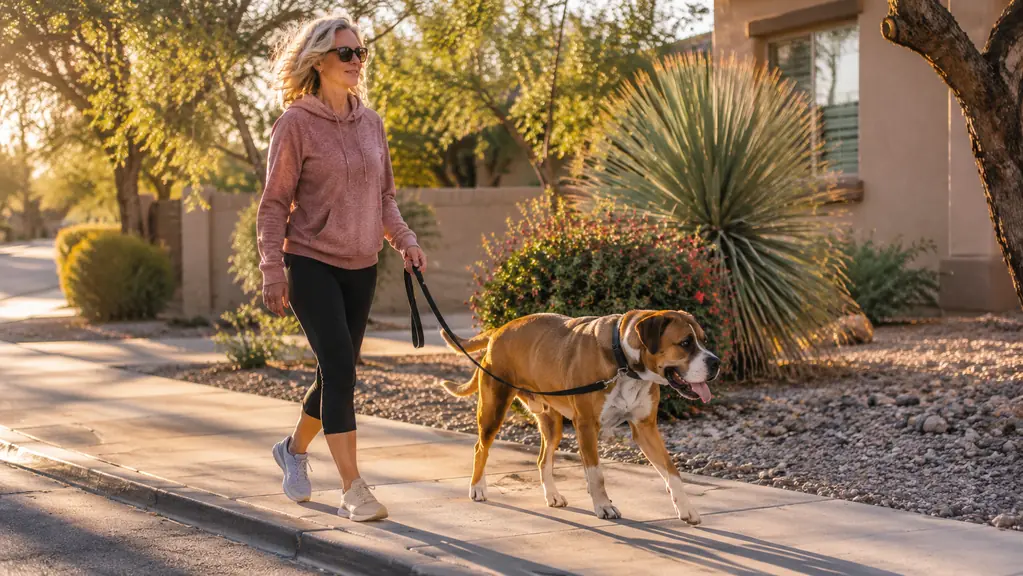
Every couple of weeks somebody at the dog park asks me the same question, usually while Biscuit is leaning into her leash toward a dropped tortilla chip. They have a strong dog. Their shoulder aches by the end of the block. They want to know which no-pull harness actually holds. Lately the same two names keep coming up: the rabbitgoo harness and the PetSafe Easy Walk. I have a short answer and a long one, and the short one is not the useful one.
Here is the short answer. For a broad-chested pit bull who pulls hard, I would put the rabbitgoo on the dog and keep it there, because it is the one I have buckled every morning for two years and it is still hanging on the hook by my back door. Now the part I want said out loud before you read another word. I have never owned the PetSafe Easy Walk. I have never put one on Biscuit. Everything I say about it comes from reading its listing and its label details and from listening to other pit bull owners at the park, a few of whom have used one for years. This is not a side-by-side test of two harnesses in my house. It is one harness I know from the inside, held up next to one I know from the outside, and I will tell you plainly which parts of that I am sure about.
| rabbitgoo Harness | PetSafe Easy Walk | |
|---|---|---|
| Leash attachment points | Two metal hook loops, one on the chest and one on the back | One clip, worn at the chest |
| How it steers a hard puller | The front clip turns the dog with a steady pull rather than a sharp correction | A martingale loop draws snug across the chest as the dog pulls |
| Padding across the chest | Polyester vest with breathable mesh and a padded front panel | Lighter webbing with less padding under the chest |
| Adjustment | Four adjustable straps, each one moves on its own | Adjusts at the chest and around the girth |
| Getting it on at the door | Over the head, then the buckles, and you also choose which loop to use | Over the head, one clip, nothing to decide |
| Visibility after dark | Reflective strips front and back | Plain webbing on the version I read about |
| Chew resistance | Not chew proof. Biscuit has never once gone after it | Not chew proof either |
| Best for | One harness for the morning walk, the car and slow evenings | A hard puller who has already beaten a front clip |
I did not go looking for a harness because I like gear. I went looking because of a gravel path.
Two years ago Biscuit caught a scent and hit the end of a six foot leash while we were walking the gravel path behind our neighborhood. I went down on one knee about sixty feet from my own back door. Nothing broke except my pride. Up to that point we had a flat collar and a leash and that was the entire sum of our equipment. I had never owned a harness of any kind, for any dog. I adopted her from a shelter here in Albuquerque four years ago when she was about two, and for the first two years of her life with me I simply did not know that a collar was the wrong tool for a dog built like a small tractor.
What I wanted was simple. I wanted something that did not close down on her throat when she pulled, and I wanted a place to hook the leash that was not her windpipe. The rabbitgoo had two metal hook loops and a front panel that sat across her chest instead of over her neck. It came in a week. It fit her fifty-eight pound frame once I adjusted the straps, and I have not had to think about fit since.
Within the first two weeks I noticed the difference, and I want to be careful about how I describe it, because a lot of writing about no-pull harnesses reads like the dog becomes a different animal. Biscuit did not become a different animal. She still pulls. What changed is that when she hit the end of the leash, her chest turned toward me instead of her whole body leaning forward into the collar. That small turn gave me half a second to get my feet back under me. Two years on, my shoulder does not ache after a walk, and I can hold her with one hand while I lock the front door with the other.
The Two-Clip Question
The rabbitgoo has two leash attachment points, one on the chest and one on the back, and learning to use them properly is most of what I know after two years. The front loop is the steering loop. Hook the leash there and a pull turns her. The back loop is the relaxed loop. Hook it there and she walks like a normal dog on a normal evening.
Our routine settled quickly. Front clip for the morning walk around the block, because that is when the neighborhood is full of interesting smells and other dogs and that is when she is at her worst. Back clip for the RAV4 and for the slow strolls after dinner when she is already tired and I mostly want her close to me. It hangs on a hook by the back door. I have never needed a second harness for a different job, and I like that more than I expected to.
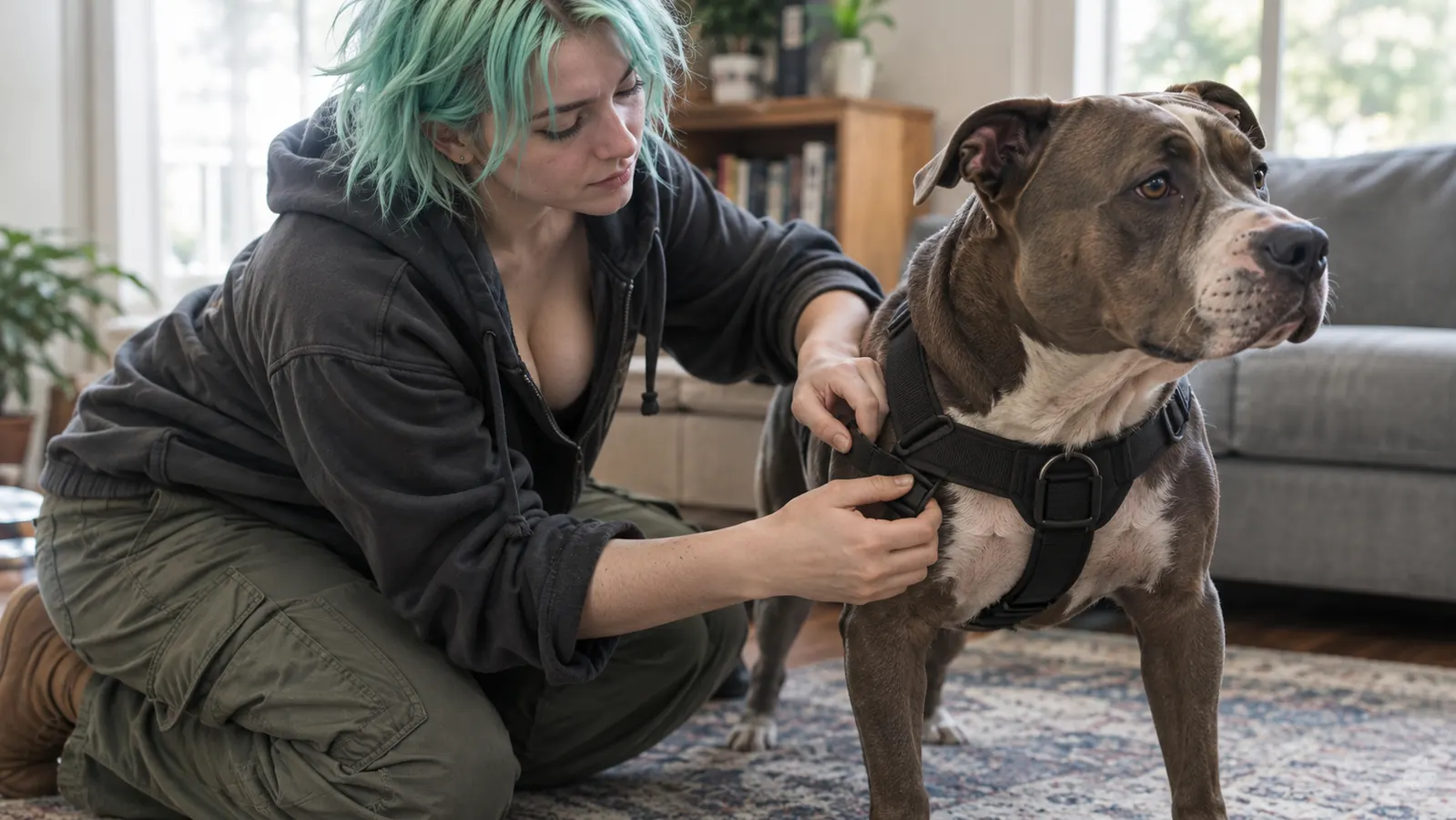
Four straps adjust on the rabbitgoo, and that is the part I did not appreciate at first. A pit bull is not shaped like a Labrador. Biscuit is deep through the chest and narrow at the waist, and most gear that fits her chest is baggy around her ribs. Because the straps move independently I could take in the girth without pinching her shoulders. It took three tries in the living room with her standing on the rug, and then I stopped thinking about it entirely.
Two weeks in, the change was not that she stopped pulling. It was that when she hit the end of the leash, her chest turned toward me instead of her whole body leaning forward.
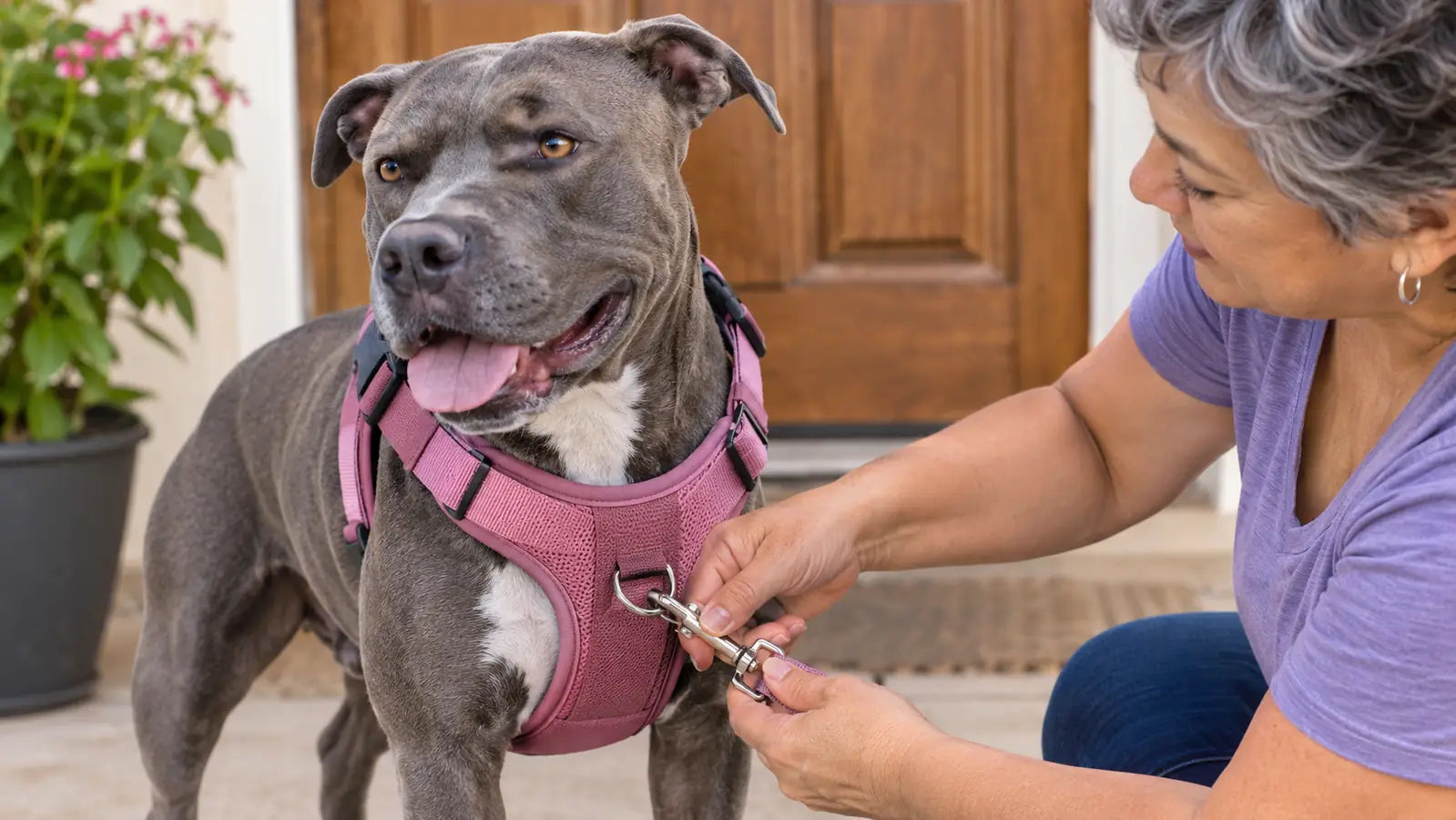
Where the rabbitgoo Harness Wins
The first place it wins is comfort on a broad chest. The vest is polyester with a breathable mesh lining, and there is real padding across the front where a pulling dog leans. On a hot Albuquerque morning in July, Biscuit is not fighting the gear or trying to shake it off. That counts for more than it sounds like, because a dog who is uncomfortable in a harness pulls harder just to get the walk over with faster.
The second place is having two attachments instead of one. If you walk the same route every single day and your dog has one specific problem, one clip is plenty and I would not argue with you. But if your week looks like mine, front clip for the busy morning and back clip for the car and the slow evenings, then one piece of equipment covers all of it and you are not swapping harnesses at the door. The reflective strips front and back are the third thing. In January I am walking before the sun is up, and on my street that is not a small detail.
Where the PetSafe Easy Walk Wins
I am not going to pretend the Easy Walk has nothing on mine, because it does. It is a front-clip harness with a martingale loop across the chest, and that loop is the entire idea. As the dog pulls, the loop draws the front of the harness snug across the chest, which turns the dog and takes the leverage out of the pull. Owners I have talked with at the park describe it as a firmer, quicker response than what I get from the rabbitgoo front clip. When a dog is genuinely committed to dragging you down the block, that extra firmness is the thing that finally gets their attention.
The second place it wins is the handler's learning curve. One clip, one place, nothing to remember at six in the morning. I have stood at my own back door in the dark trying to work out which loop I had the leash on, and I have hooked the wrong one and spent a whole block wondering why Biscuit was surging again. With the Easy Walk that particular mistake is not available to you, and for some people that alone is worth the trade.
What I Would Ask Before Buying Either One
Before you buy anything, walk your dog on what you have and watch where the pressure lands. If the leash goes taut at the throat, you already know a collar is the wrong tool and you are choosing between two harnesses rather than between a harness and a collar. If your dog is limping, holding a leg up, or has a joint problem your vet has already diagnosed, ask your vet before you change gear. I am a grandmother with one dog and a sore shoulder, not a trainer, and no harness fixes a body that hurts.
The other question is what your week actually looks like. If you take one walk a day on the same route, the simpler harness is probably the right one. If you are loading a dog into the back of a small SUV, walking in the dark half the year, and taking a long slow loop on the weekends, count how many different jobs you are asking one piece of webbing to do. That count is what decided it for me, and it is the reason I stopped looking after the first two weeks.
The harness that turned Biscuit's pull into a turn instead of a drag
Two metal hook loops, four adjustable straps, breathable mesh and reflective trim. Front clip for the morning walk, back clip for the car. Two years on the hook by my back door and it is still the only harness I own.
Amazon Check today's price on Amazon →The Fit Question Nobody Warns You About
Here is the part that decides more than any feature list. A harness only steers if it sits still, and it only sits still if it fits. A broad-chested dog in a harness that is too loose will slide the whole vest around until the front clip is under one armpit. At that point you are not steering anything. You are just pulling a dog in a coat, and the dog is winning.
Measure the chest behind the front legs, not the neck, and check that number against the size chart rather than against a breed name. I had to take up the girth straps well past where I first set them, and I did it on the rug in the living room where I could see all four sides of her. Then walk a block before you decide anything. A harness that feels right standing still can shift once a dog plants her feet, and a dog can back out of one that is loose. That advice costs nothing and it is the most useful thing I know.
Who Should Buy Which
Buy the rabbitgoo if your dog is broad through the chest, if you want one harness for the walk and the car, and if you are willing to give it two weeks and a few minutes of strap adjusting on the first day. Buy it also if you walk before sunrise, because of the reflective strips. Two years in, the straps are not frayed and the buckles still click. It reduced Biscuit's pulling. It did not end it. I would rather tell you that than hand you a story about a dog who never pulls again.
Look hard at the PetSafe Easy Walk if you have a hard puller who has already beaten one front-clip harness, or if steering matters more to you than padding and you want the firmest front-clip help available. Look at it too if you want one obvious attachment and no decisions to make at the door. What I would not do is buy it expecting a padded vest, because that is not what it is, and I would not buy it planning to use the same chest loop for both the busy morning walk and the tired evening one. With one clip, that is the only choice you get.
Broad in the chest and strong on the leash? Start here.
Measure the chest behind the front legs, set the four straps on the rug at home, and give it two weeks before you judge it. That is exactly how I got from a sore shoulder to a walk I can hold with one hand.
Amazon Check the current price on Amazon →