
I bought the rabbitgoo harness two years ago, the day after Biscuit pulled me off balance on a gravel path along the arroyo near our house. I did not go down. I came close enough that a neighbor crossing the street asked if I was all right, and I said I was fine, and then I walked home and ordered a harness from my kitchen table with my reading glasses still on. That is the whole origin story. No research, no forum threads, no comparison shopping. Just a 56-year-old woman who did not want to hit the ground behind her own dog.
Biscuit is a 6-year-old blue-nose American pit bull terrier, 58 pounds, and she is the only dog I have. Before that Tuesday she wore a flat collar and a six foot leash, and that was the entire history of our walking equipment. The collar was fine for a dog who strolls. Biscuit does not stroll. She leans into the leash and treats the first block like a race she intends to win, and my shoulder paid for it. I have now used the rabbitgoo harness on every morning walk for two years straight, and it still lives on a hook by my back door. Here is what that has actually been like, including the parts that are not flattering to the harness.
The Quick Verdict
It cut the pulling noticeably within two weeks and it has survived two years of daily walks. It did not turn Biscuit into a dog who ignores squirrels, and no harness on a shelf will.
Amazon Check Today's Price →The harness that stopped Biscuit from towing me down my own sidewalk
Two leash clips, four adjustable straps, breathable mesh, and reflective strips for the dark morning walks. Two years in and it is still the one on the hook by my door.
Amazon Check Today's Price on Amazon →How I've Used It
The harness comes off that hook every single morning somewhere between 6:15 and 7:00. In two years I can count on one hand the walks Biscuit has taken without it. I loosen the straps, slide it on her, fasten the buckle, and we go. The whole thing takes under a minute now. It took longer at the start, because I was adjusting four separate straps and second-guessing every one of them, and a harness that is set wrong is worse than a collar.
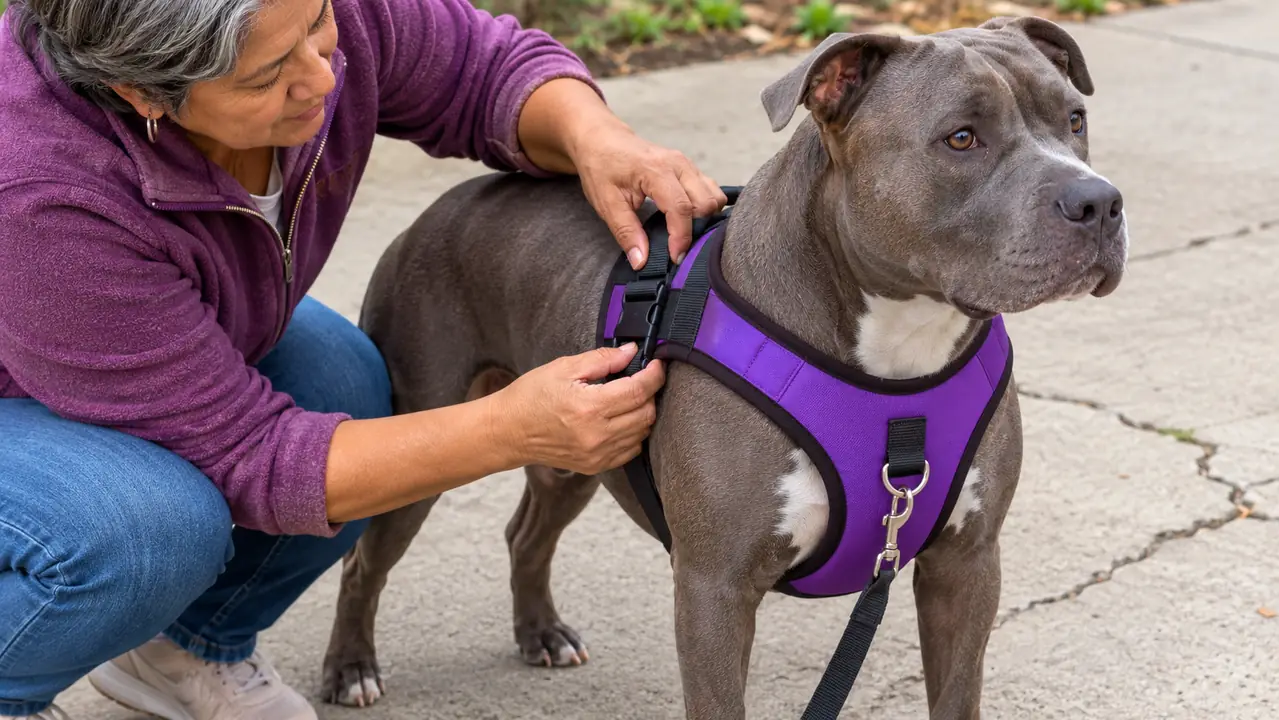
The rabbitgoo has two leash clips, one across the chest and one on the back, and I use them for different jobs. The chest clip is what we walk with. The back clip is what we use for slow evening strolls and for the car. If you only ever use one, use the chest one. That is the one that changed my mornings.
I want to be plain about the result. It reduced the pulling, it did not end it. Within the first two weeks I noticed I was no longer bracing my whole body at the start of every walk, that little lean back I had been doing for four years without thinking about it. By the end of the first month I could hold the leash in one hand and a coffee in the other on the flat stretches. She still pulls. She pulls less, and the pulling is no longer aimed at my shoulder.
The Two Clips, and Why I Use Them Differently
The chest clip is the reason I am still using this harness two years later. With the leash on the chest loop, Biscuit's own forward motion turns her slightly toward me instead of dragging me straight ahead. Nothing about that is a trick and nothing about it is instant. It is a lever, and the lever happens to work on a dog her shape.
The back clip I use differently. On a slow evening walk around the block, when she is sniffing every third bush and in no hurry at all, the back clip keeps the leash off her chest and out from under her front legs. I also use it in the RAV4. I run a short tether from the back loop to a seat anchor so she cannot climb into the front seat with me on the way to the vet. I am not going to tell you that is crash protection, because I do not know that it is, and I would rather you know exactly what I do than believe something I cannot back up.
Switching between the two clips takes about five seconds. That matters more than I expected it to. The harness I almost bought instead, the PetSafe Easy Walk, is a front clip design as far as I can tell from its listing, and I have never owned one, so I cannot compare them from personal use. What I can tell you is that having both attachment points on one harness meant I did not have to buy a second piece of equipment for the car.
What Two Years of Daily Use Has Done to It
The fabric is polyester with mesh panels, and after two years of daily walks, rain, and Albuquerque dust, the mesh is the part that has aged. It has lost some of its crispness where the chest strap crosses her shoulders, and it has softened enough that I notice it when I pick the harness up. The stitching at both metal hook loops is intact. I checked it again this morning, because I go over the whole thing about once a month, and there is nothing frayed at either attachment point.
The reflective strips are still doing their job. I walk before sunrise from October through March, and cars coming up our street pick her up from a good distance. That is not a small thing on a 58-pound dog at 6:30 in the dark on a street with no sidewalk on one side. Two winters of grit and sink rinses have dulled them a little, but they still catch headlights.
Cleaning is a rinse in the laundry sink with a little dish soap, a rub with a rag, and hanging it back on the hook to dry overnight. I have never put it in the washing machine and I probably never will. The buckle has never once popped open on its own, and that was the failure I worried about most during the first month, because a dog who backs out of a harness on a busy street is a real problem.
Fit on a 58-Pound Pit Bull
Biscuit has the shape that makes harness shopping annoying: a deep chest, a thick neck, and a waist that is narrower than the chest by a good four inches. The rabbitgoo is sized by chest measurement, 21 to 38 inches on this one, and her chest sits inside that range with room left over. I measured her with a cloth tape on the kitchen floor, ordered, and spent the first week adjusting the four straps a little at a time.
Two of the four straps I set once and have not touched since. The neck straps took real fiddling. I had them too loose for the first three days and the harness shifted around on her shoulders when she trotted, which made me nervous. That was my adjustment error and not a design flaw. Once I tightened the neck straps and rechecked them over a week of walks, it stayed put, including on the two occasions she has gone after a cat.
The harness itself weighs 8.64 ounces. On a 58-pound dog that is nothing. She does not walk differently in it, she does not rub at it, and she does not hesitate at the door when I pick it up off the hook. A dog who hated a piece of equipment would tell you plainly. She waits for it.
One more thing that matters in this climate: the mesh panels breathe. Albuquerque in July is 95 degrees by 9 in the morning, and a dog in a padded vest can overheat fast. I still do not walk her in the heat of the day, and I still carry water. The harness is not a cooling device. It just is not the extra blanket I was afraid it would be.
What It Does Not Fix
If you are hoping a harness will turn a dog who wants to chase things into a dog who ignores them, this is not that, and nothing on a shelf is. Biscuit still lights up at a squirrel. She still pulls toward the dogs on the far side of the street. What changed is the amount of force I feel in my hand, and the fact that I can redirect her with a short tug and keep walking instead of planting both feet and hauling her backward.
There is also the honest limit of what a harness is. This is a piece of walking equipment, not training. The two weeks where I saw clear improvement were two weeks where I was also being more consistent about stopping dead when she pulled. I do not think the harness did that work by itself. I think it made the stopping possible, which is a different and smaller claim, and it is the one I will stand behind.
And if your dog is a serious, hard puller who has already learned to lean sideways against a chest clip, a harness alone will not solve it. My neighbor's dog does exactly that. That is a training question and probably a trainer, and I am not qualified to advise you on either. Ask your vet for a referral if you are at that point.
How It Compares to What I Considered
I looked at the PetSafe Easy Walk before I bought anything, and I have never used one. I am judging it from its listing and from what two pit bull owners at the dog park told me. The Easy Walk is a front clip design with one attachment point, and the people I talked to either loved it or said their dog figured out how to pull sideways against it. I went with the rabbitgoo because it gave me the front clip for walks and the back clip for the car in one piece, and because it was available the week I needed it.
If you want the longer version of that comparison, I wrote it out separately, because it deserves more than a paragraph, and I am not going to pretend I have hands-on experience I do not have.
What I Liked
- The chest clip cut Biscuit's pulling noticeably inside the first two weeks
- Two leash attachment points, so one harness covers walks and the car
- Four adjustable straps fit a deep-chested 58-pound pit bull without fighting it
- Reflective strips are still readable after two winters of pre-dawn walks
- 8.64 ounces, and she genuinely does not seem to notice she is wearing it
Where It Falls Short
- It reduced pulling, it did not stop it, and it will not stop a determined chase
- The mesh at the shoulders has softened and dulled after two years of daily use
- The first week of strap adjustment is fiddly, and getting it wrong makes the fit worse
- It is not a training tool on its own. You still have to stop when the dog pulls
It reduced the pulling by about half in the first two weeks. Two years later it is still the harness on the hook by my back door, and I have not gone looking for another one.
Who This Is For
This is for the owner of a strong, medium-to-large dog who is tired of being towed. If you are the one absorbing the force on every walk, if your shoulder or your wrist aches after the first block, if you have started choosing routes by which one has the fewest other dogs on it, a front clip harness is the first thing worth trying, and this one has held up for two years of daily use on a 58-pound pit bull in a dusty climate. It is also for the person who wants one harness to do both jobs, the walk and the ride to the vet, instead of buying two.
Who Should Skip It
Skip it if your dog has already learned to pull sideways against a chest clip, because that is a real thing that happens and this harness will not outsmart a dog who has figured it out. Skip it if you need equipment built for lifting a heavy dog into a truck, because that is a different category of gear and you should shop for it directly. Skip it if you want the harness to do the training for you. And skip it if you are not willing to spend a week adjusting four straps, because the fit is the whole thing and a loose harness on a strong dog is worse than useless.
Two years, one harness, and a shoulder that finally stopped aching
Front clip for the walks, back clip for the car, four straps to fit a deep chest, and reflective strips for the dark mornings. Same harness Biscuit has worn every day since the gravel path.
Amazon Check Today's Price on Amazon →