
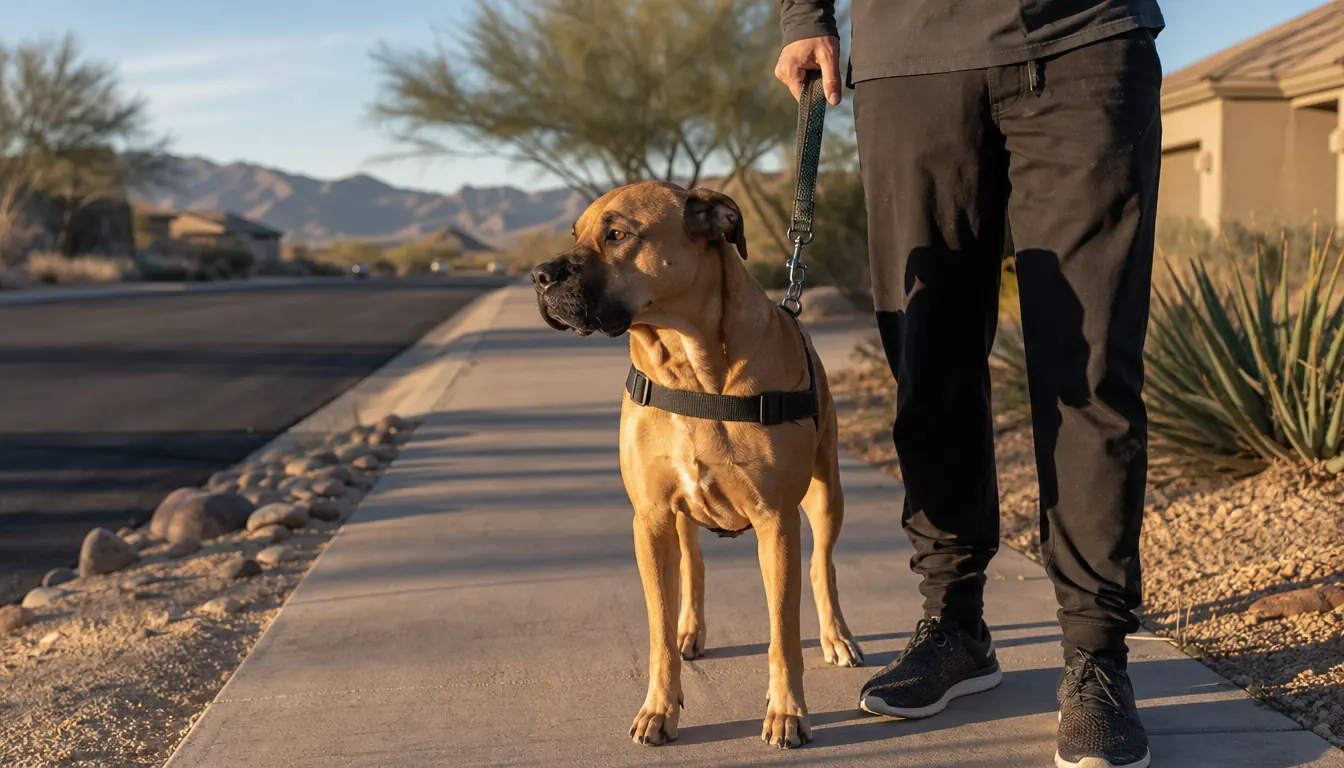
Biscuit is a 58 pound blue-nose pit bull, six years old now, and two years ago she pulled me off balance on a gravel path behind the neighborhood school. I did not fall. I came close enough that I stood there holding the leash with both hands, embarrassed and a little scared, and that was the morning the flat collar stopped being good enough.
That collar and a six foot leash were all we had for the first two years. I had never bought a harness of any kind and I did not know what I did not know: a harness is not a switch you flip. It is equipment that helps you teach a walk, and if you skip the teaching part you end up with a strong dog in a nice vest who still pulls. What follows is what I actually did with the rabbitgoo harness I have used every single morning since, in the order I did it, including the parts that did not work the way I hoped.
The harness that got Biscuit and me around the block without a wrestling match
Two metal leash loops, four adjustable straps, breathable mesh and reflective strips. Measure the chest first, then set the straps. Fitting it takes about five minutes the first time.
Amazon Check Today's Price on Amazon →Before You Start: What the Harness Can and Cannot Do
I want to be straight with you, because I spent the first couple of months expecting something the gear cannot deliver. A no-pull harness does not train your dog. What it does is take away the leverage. A pit bull who leans into a flat collar can drag a grown adult down a sidewalk, and that collar puts the pressure right at the front of the throat, which is exactly where a determined dog pulls harder. A harness spreads the load across the chest and shoulders, and the front leash loop turns the dog toward you when she surges. That buys you the half second you need to give a cue. The teaching is still your job.
For Biscuit the change was real but partial. Within the first two weeks the morning walk stopped being a wrestling match. It did not turn into a stroll where the leash hangs in a perfect loop the whole way. Even now, two years in, if a rabbit breaks out of the hedge she will hit the end of that leash. But I stay on my feet, I can turn her, and we keep going. That is the honest version of what to expect, and knowing it up front saved me a lot of frustration when the rabbitgoo harness did not magically produce a dog who heels.
Step 1: Measure the chest before you order anything
Put the dog on flat ground and stand her up. Run a soft tape around the widest part of the ribcage, just behind the front legs, and write the number down. The rabbitgoo harness in X-Large is built for a chest between 21 and 38 inches, and that measurement is the one that matters. Not the weight on the bag of food, and not how big your dog looks next to a Labrador at the park.
Biscuit is 58 pounds and her chest measurement landed comfortably inside that X-Large range, which is why the box that arrived was the right box. I never had a size letter to argue with. If your dog measures near the top of a range, size up rather than down, because four adjustable straps can take up slack but they cannot add fabric that is not there.
Here is what I got wrong the first week. I measured her right after a walk when she was still panting and wiggling and generally being a goof. Measure a calm dog. Otherwise you will set everything too loose to be useful and then spend a month wondering why the harness shifts sideways every time she pulls.
Step 2: Set all four straps before the first real walk
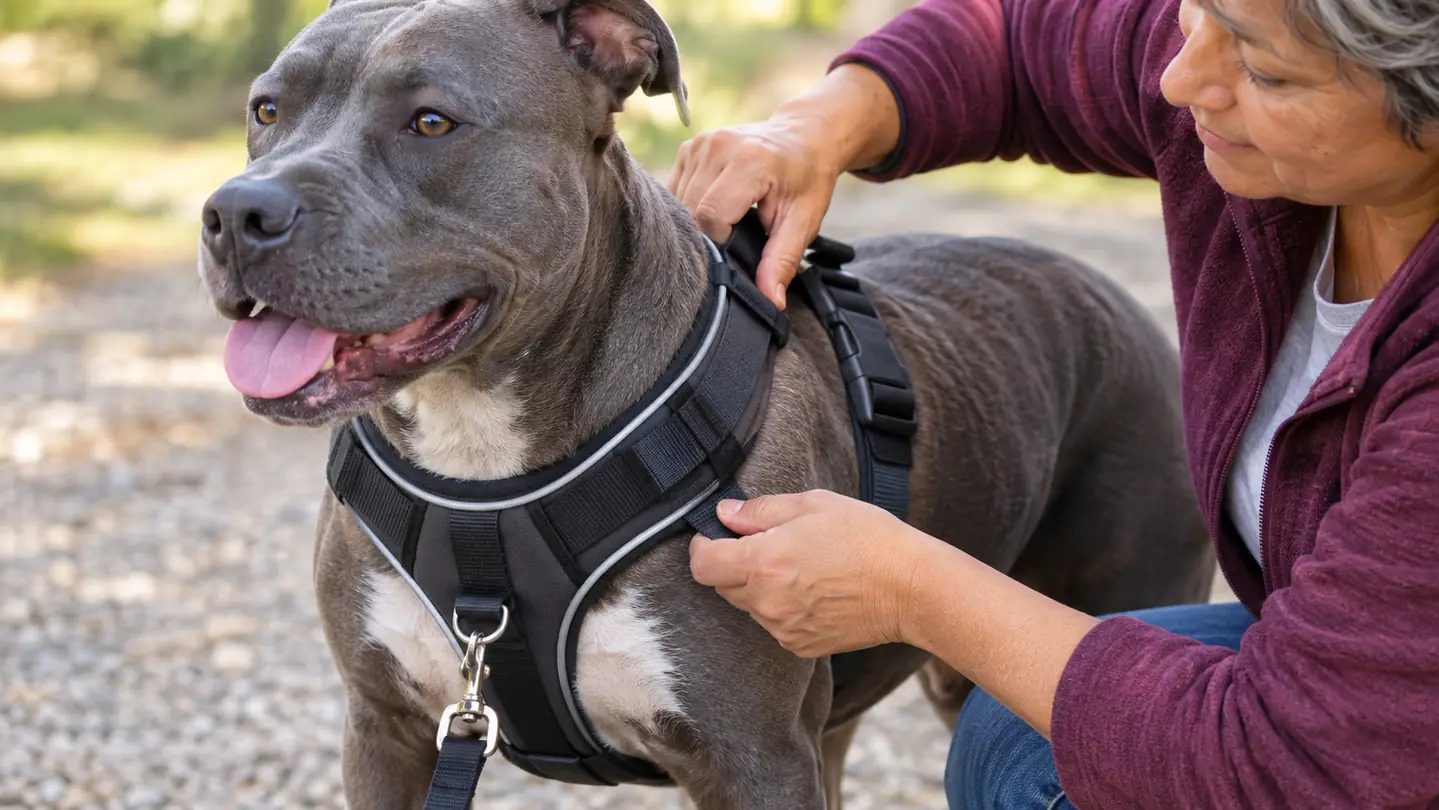
Loosen everything first. Then slide the harness over her head, fasten the buckle, and adjust one strap at a time. The rabbitgoo harness has four fully adjustable straps, and the temptation is to yank them all tight at once and call it done. Do not. Work around the body: snug at the chest, snug behind the shoulders, and check that the breathable mesh lies flat instead of bunching up behind the front legs.
My test is simple and I use it every time I put the thing on. I should be able to slide two fingers under any strap, and no more. If my whole hand fits, it is loose enough to slip. If I cannot get two fingers in, it is tight enough to rub. The buckle should close with a clean click and sit flat against the fabric, not dig into the point of the shoulder.
Then take five minutes in the yard before you go anywhere. Watch her walk, trot and turn. Look for rubbing at the front of the chest and under the front legs, and watch whether she can back out of it. Biscuit did a fair amount of dramatic flopping on the grass the first time I put it on her, and I let her carry on. By day three she was wearing it around the house without noticing, and that is a better first lesson than a battle on the sidewalk.
Step 3: Walk from the front loop, use the back loop for easy days
There are two sturdy metal hook loops on the rabbitgoo harness, one at the chest and one on the back, and they do different jobs. For the daily neighborhood walk I clip the leash to the front loop. When Biscuit surges ahead, that front connection pulls her shoulder around toward me, so she cannot set her weight and lean into the leash the way she did with a collar.
The back loop is for the RAV4 and for slow evenings when we are only going to the end of the block and back. It is the loop I use when I want her to walk ahead and sniff, which is most of what she actually enjoys about being outside. On a back clip she can still pull, and she does, so I save it for short and easy trips rather than the long morning loop.
Pick one loop per walk and stay with it. Switching mid-walk, which I did for a while out of pure confusion, only teaches the dog that the rules change depending on your mood. That is not a lesson you want a 58 pound dog learning.
The last thing about the front loop is that you cannot use it like a brake. I hold the leash with a loose hand and let the harness do the turning. The first week I kept a death grip on it and my shoulder paid for it. Soft hands, short leash, let the dog feel the turn.
The rabbitgoo harness cut the pulling roughly in half inside two weeks. It did not turn Biscuit into a dog who never hits the end of the leash. That part was me, on the same sidewalk, every morning.
Step 4: Teach the walk, because the gear cannot do it for you
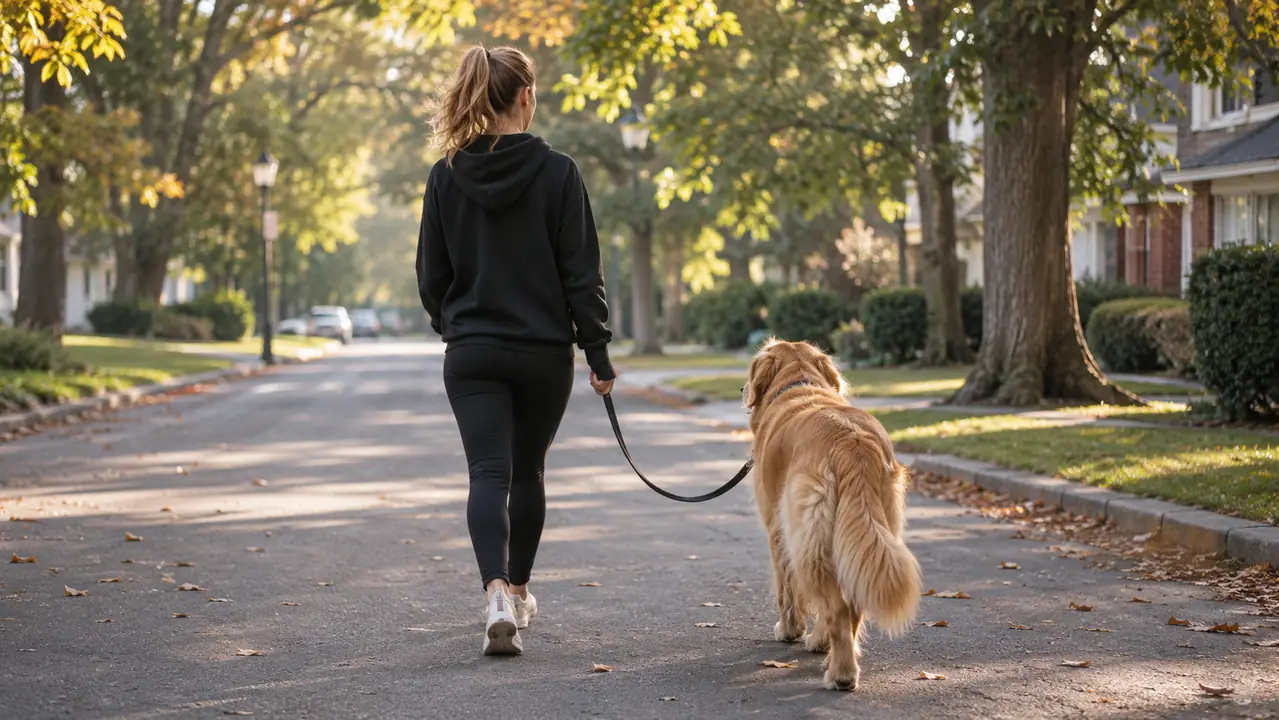
Here is the part nobody sells you. The harness gives you control, but it does not tell the dog where to be. The cue that finally worked for us was boring and repetitive: the moment the leash goes tight, I stop. Not pull back, not correct, not say anything clever. I stop and stand still until she looks back at me, then we go again.
The second cue was turning. When she locked onto something and would not give, I turned and walked the other way. Every time. Even when it meant crossing the same street twice in one block and feeling ridiculous in front of the neighbors. She figured out in about ten days that pulling forward produced nothing, and that staying near my left knee produced forward motion. That is the whole lesson. The harness just made it possible to deliver it without getting dragged.
Keep the sessions short at first. Ten minutes twice a day beats one long battle around the entire neighborhood, especially in Albuquerque heat. Once she was getting it right eight times out of ten on our own quiet street, we started taking the longer loop past the school, where the kids are loud and the smells are much better and my dog's brain turns to soup.
Step 5: Give it two weeks and measure the right thing
I noticed a difference in the first two weeks, and I want to describe exactly what that difference was, because it was not what I had hoped for. She still pulled. What changed was how quickly she came back. Before the harness, once she hit the end of the leash the walk was over as far as she was concerned and I was along for the ride. After two weeks, she would hit the end, feel the front loop turn her, and come back to my knee on her own maybe half the time.
That is the number to watch: recovery time, not perfection. Count how many seconds it takes your dog to come back to a loose leash after she lunges at something. If that count goes down over two weeks, the system is working and you should keep going. If it does not move at all, check your fit before you blame the dog, because a rabbitgoo harness that is too loose slides around and gives no feedback at all.
Two habits came out of the last two years and both are boring. I check the straps, the stitching and both metal loops once a month, especially after a summer of dust and grit works its way into everything. And I look over the reflective strips before any early walk, because on a dark residential street in winter that trim is the difference between a driver seeing us and a driver not seeing us. The harness also carries a full warranty for quality issues, which I have been glad to have and have not yet needed to use.
What Else Helps
Four things made more difference than I expected. The first is a pocket of small treats and a dog who is actually interested in them, because you cannot reward a loose leash if you have nothing to reward it with. The second is skipping the retractable leash entirely. Constant tension on a thin line teaches a strong dog nothing, and I have watched a neighbor get pulled off her feet by one. The third is a short walk before the walk. Five minutes of sniffing in the backyard takes the edge off before we hit the street where all the triggers live.
The fourth is a phone call. If your pit bull is a sudden, brand new puller, or if she seems stiff in the back end after a walk, ask your vet before you buy any gear at all. Biscuit's pulling was habit and strength, not pain, but I had that checked early because a dog who hurts will pull strangely and no harness on earth fixes that.
And keep a plain flat collar on for the tags. The rabbitgoo harness handles the walking, the collar handles the license and the rabies tag, and nobody has to fish around in the mesh at the front door while a dog spins in circles. It is a small thing that made leaving the house less annoying every single morning.
Two years, one harness, and a walk I can finally enjoy
Four adjustable straps, two metal leash loops, breathable mesh and reflective strips. Measure the chest, set the straps, clip to the front loop, and give it two honest weeks.
Amazon Check Today's Price on Amazon →