
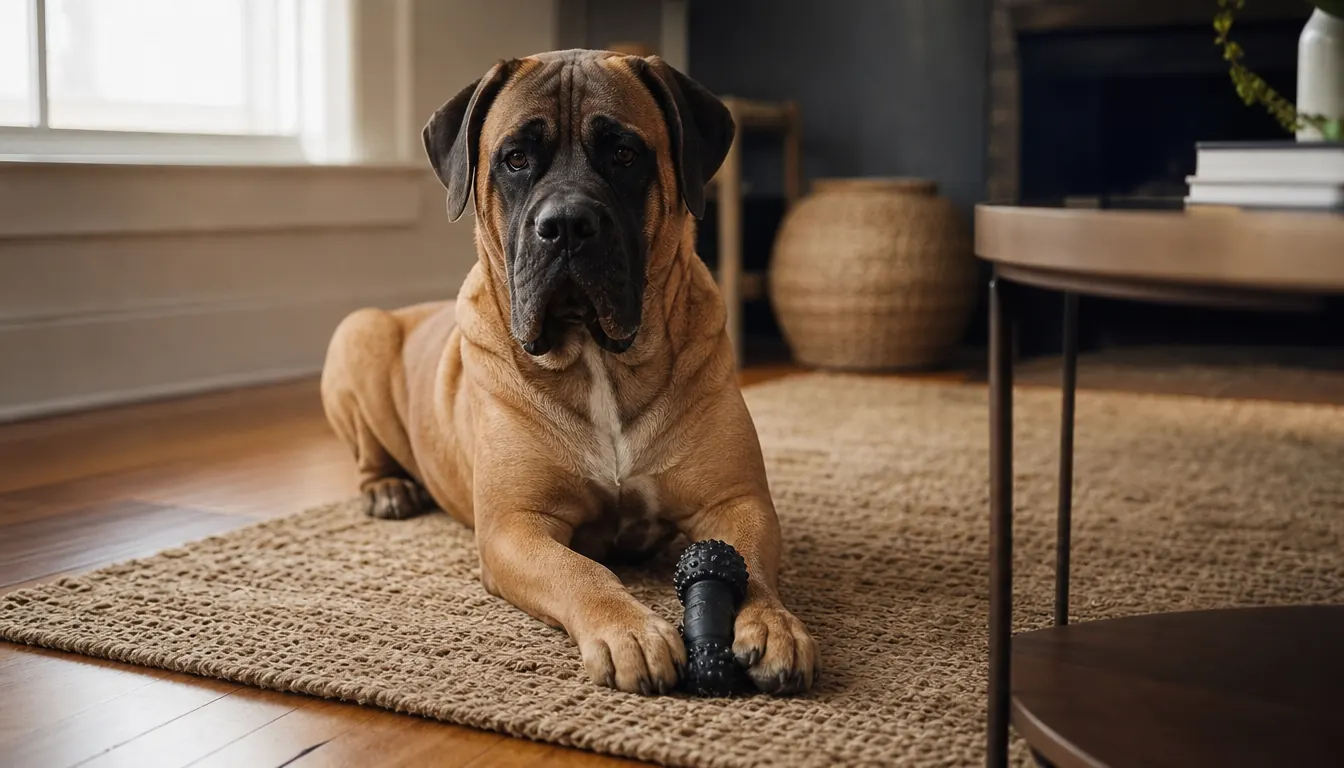
Biscuit does not chew things up out of spite. She chews because she is a 58 pound blue-nose pit bull with a jaw built for work and a brain that needs a job, and on the days she has no job, she assigns herself one. Her assignments have cost me two foam beds and a kitchen trash bag full of plush toy parts. I am 56, retired from the front office of a school, and I have spent a lot of years explaining to people that a dog like mine is not a monster. But I will also tell you the truth, which is that a bored pit bull will redecorate your living room and not ask permission first.
Three years ago I bought a KONG Extreme in size Large. It is thick natural rubber, hollow in the middle, and it weighs a bit under eight ounces, which matters more than it sounds like it should, because a light toy gets batted under the couch in a minute. Before that we had plush toys and soft rubber toys, and Biscuit opened all of them like mail. The KONG Extreme is the only chew toy I have bought in three years that is still in this house. Tooth marks, yes. Pieces missing, no. Here is exactly how I use it, in five steps.
The One Rubber Toy That Outlasted Three Years of Biscuit
Size Large, thick natural rubber, hollow in the middle for stuffing. It is the only thing in this house she has not opened like an envelope.
Amazon Check Today's Price on Amazon →Step 1: Match the Size and the Material Before Anything Else
The listing says Large, and Large is what I bought, and I would buy it again for a dog her size. This is not the place to save a few dollars by going smaller. A chew toy that is too small for a 58 pound dog ends up at the back of the mouth, and things that end up at the back of the mouth come out again in pieces. If your pit bull is closer to 80 pounds, or is the kind of chewer who has ended every toy you have ever brought home, this is still where I would start, because the rubber is thick and it has held up to the kind of jaw pressure that finishes most toys in an afternoon.
The other half of this step is the material. Soft rubber and plush both fail the same way with a dog like Biscuit, which is quickly and with a mess on the rug. Natural rubber has some give to it, so the teeth sink in a little and then release instead of tearing straight through. I am not going to tell you the KONG Extreme is indestructible, because nothing is, and any product that promises that has not met a determined pit bull. What I will tell you is that three years in, mine carries tooth marks and is not missing anything.
The first month I had Biscuit, I bought what the pet store had on the shelf: a plush squirrel with a squeaker, a soft rubber ring, and a rope. The squirrel lasted about eleven minutes. The ring lasted a day and a half, and the piece she pulled off it was the size of my thumb, which is the day I stopped buying soft rubber. I am not telling you not to buy those things. I am telling you that with a jaw like hers they are a subscription, not a purchase, and I got tired of the routine.
Step 2: Stuff It So the Work Lasts Longer Than Four Minutes
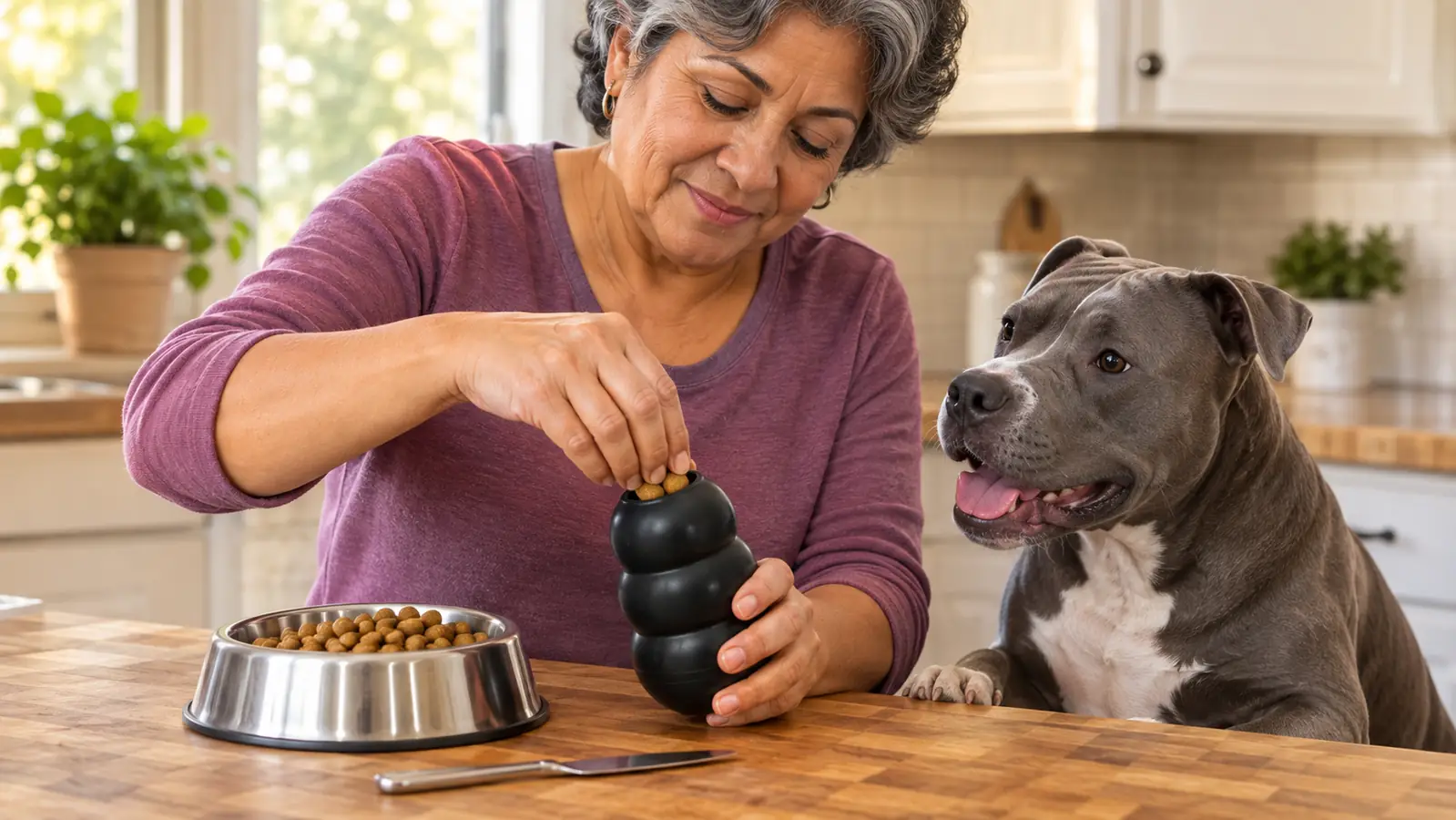
A dry hollow toy is a two minute toy. The whole reason the hollow center matters is that you can pack food into it, and the packing is what turns a chew into a project. I use plain kibble for the base and a little peanut butter to hold it together. Read the peanut butter label every single time and make sure it says xylitol free, because xylitol is genuinely dangerous to dogs and it keeps showing up in more products every year. If you are not certain about a brand, ask your vet before you use it.
Here is the packing method that works for us. I fill the hollow with kibble, then push a thin layer of peanut butter down against it with a butter knife, then more kibble, then a cap of peanut butter across the opening. The peanut butter is the lock. Without it, the kibble falls out the moment she lifts her head and the whole thing is finished. With it, she has to work her tongue and her jaw to get anything loose, and that working is the part that tires her out.
I also vary the stuffing, because a dog who gets the same thing every day stops treating it as work. Kibble one day. A little canned food smeared inside the next. Some of the KONG snacks when I have remembered to order them. The variety is what keeps her interested, and interest is what buys me a quiet hour in the afternoon.
Step 3: Freeze It Overnight and Stop Handing It Over Warm
This is the step that changed the whole routine for us, and it costs nothing but a little planning. I stuff the toy in the evening, put it in the freezer door, and give it to her the next afternoon. Frozen, the peanut butter and the kibble take real effort to get out, and the cold rubber feels good on the gums. A warm stuffed toy is a ten minute snack. A frozen one is usually closer to forty minutes of steady, quiet work on the rug.
I own exactly one KONG Extreme, so the routine stays simple. It lives in the freezer door between uses, which is also where I remember to look when I am making dinner and realize I have not set one up for tomorrow. If you have the freezer space and a more impatient dog, two would let you rotate without a gap. One has been enough for us.
The first time I froze one, I made two mistakes. I packed it so full that peanut butter pushed back out of the opening when I set it down, and I handed it over at eight in the morning, when what she wanted was a walk and not a project. She sniffed it, walked off, and I stood in the kitchen feeling foolish. Now I pack it looser, leave the opening clear, and give it in the afternoon when the house is quiet. Same toy, same freezer, completely different result. The lesson was not about the toy. It was about me getting the timing wrong.
Three years, one Large KONG Extreme, tooth marks all over it, and not one piece missing. That is the whole review.
Step 4: Hand It Over at the Bored Hour, Not the Happy Hour
Timing is the part people skip. If I hand the toy over when Biscuit is already wound up, she takes it, loses interest in three minutes, and goes looking for the couch instead. If I hand it over right as the boredom starts, usually mid afternoon when the house goes quiet, she settles onto the rug and gets to work. The toy is doing its job when the dog is quiet and busy, not when the dog is bouncing off the furniture.
I also hand it over before the harder parts of the day. Before the grandkids come over on the weekend, because she is gentle with them and I want her calm and not underfoot. Before I get on the phone. Before I go out, if I am leaving the house at all. A dog with a project is a dog who is not standing at the window working herself into a state over the mail carrier.
One thing I will say plainly, because I wish someone had said it to me earlier. Do not use this as a substitute for the walk. Chewing and walking do different jobs. The chew buys you quiet, the walk burns off the engine. Biscuit gets her morning walk in the rabbitgoo harness and her afternoon chew, and she needs both of them. Skip the walk and no chew toy on earth will fix your evening.
Step 5: Check It Once a Week and Retire It Without Guilt
Every Sunday I look the toy over. I run my thumb around the openings, flex the rubber, and check for cracks, deep gashes, or anything that looks like it is thinking about leaving. Three years in, what I find is tooth marks, which is normal and expected. What I am watching for is a loose piece. If I find one, the toy goes in the trash that same day and I do not feel bad about it.
A toy that has been through a heavy chewer's mouth is not a sentimental object. It is a piece of equipment, and equipment wears out. I would rather replace a chew toy than spend an evening at the emergency vet, and I have never once regretted throwing something away early. If you want a simple rule, check it weekly and replace it the moment the rubber starts to fail anywhere. That is the whole policy.
Here is exactly what I check, because 'look it over' is not useful advice on its own. I press my thumb into the rim of the opening, since a rim that has gone soft is the first sign the rubber is giving up. I bend the toy in half, which a healthy one takes without complaint. I turn it in the light and look for a crack that runs deeper than a tooth mark. Then I feel along the edges for anything that shifts when it should not. Three years of Sundays and I have not found one. I will keep looking.
What Else Helps
The chew is one tool, not the whole toolbox. The morning walk comes first. Biscuit pulls, and two years ago she pulled me off balance on a gravel path, which is why she now walks in a rabbitgoo harness with the leash on the front clip. That is a walking tool and nothing else. The KONG is a chewing tool and nothing else. I have made the mistake of expecting one to cover for the other, and it does not work that way.
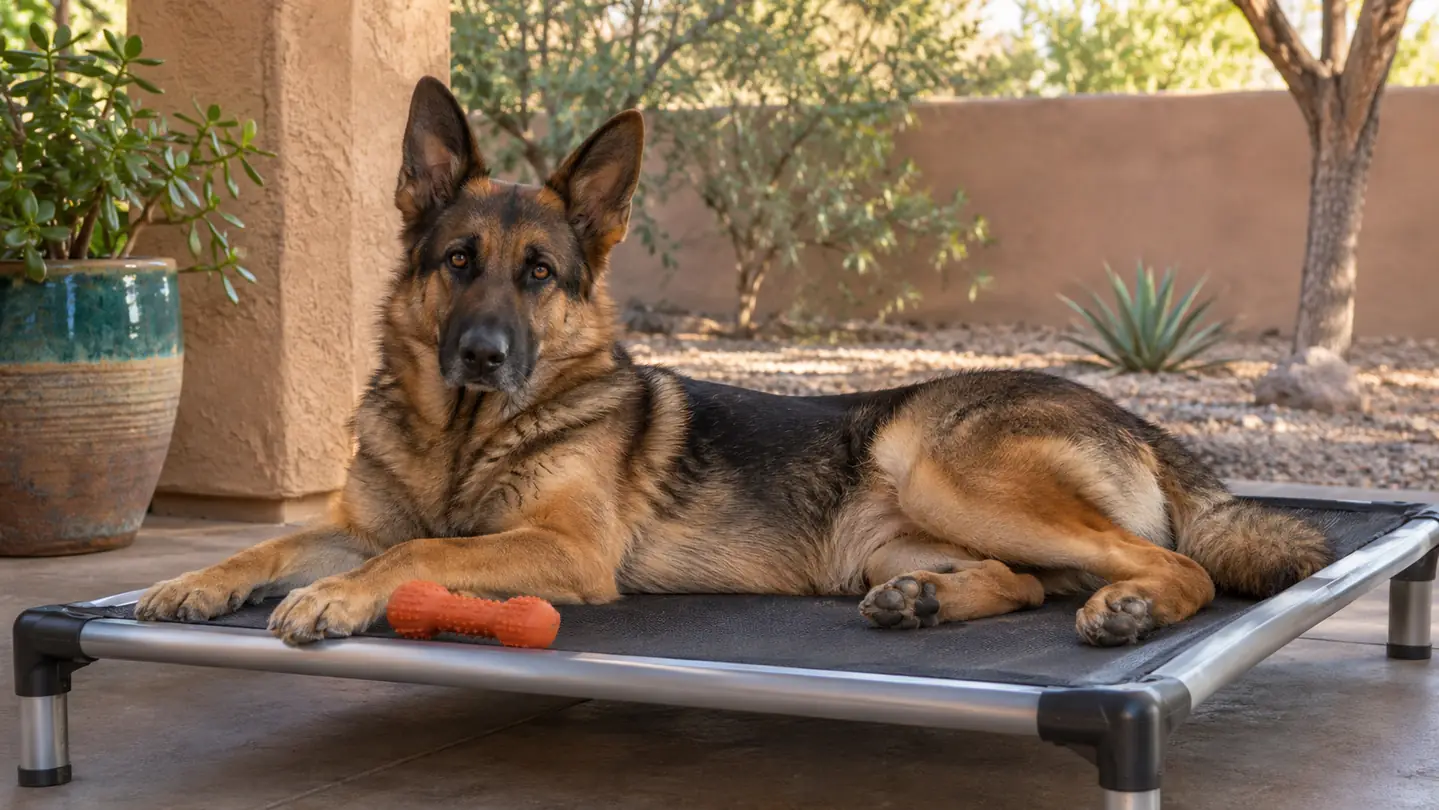
Rest matters more than most people think. Biscuit shredded two foam beds before I bought a Veehoo elevated bed, and she took about a week to trust it, and now it is where she goes when she has had enough of the day. A dog with a real place to lie down and a real thing to chew on is a much easier dog than a dog with neither. Both of those are cheap compared to a new couch.
And if your dog has itchy skin or sore paws, none of this touches that. That is a vet conversation, and food and shampoo questions belong in it. A chew toy fixes boredom. It does not fix anything medical, and anyone who tells you otherwise is selling something.
The last thing, and then I will get out of your way. Pick one time of day and one spot on the floor and do the same thing every time. Biscuit now takes herself to the rug at about two in the afternoon and sits there looking at me. Nobody trained her to do that. Three years of the same routine did it, and routine costs nothing. If you take only one thing off this page, take that one.
One Toy, Five Steps, and a Quieter Afternoon
Size Large, thick natural rubber, hollow in the middle for stuffing. Freeze it, time it, check it every week. That is the routine that has held up for three years in this house.
Amazon Check Today's Price on Amazon →