

Biscuit went through two foam beds in under a year. The first one lasted about four months. The second one lasted nine days. I came home from the grocery store to a living room floor covered in white fluff and a 58 pound pit bull looking at me like she had done me a favor. I am 56 years old, I live in Albuquerque, and I am not a dog trainer. I am just a woman who got tired of buying the same wrong thing twice.
What I finally understood is that a bed for a strong chewer is not really a bed in the usual sense. It is a piece of furniture. A frame, a stretched surface, and no stuffing to pull out. The Veehoo chew proof elevated bed is the one that has stayed in one piece in my house, and I have had it 14 months now. What follows is how I would go about choosing one if I were starting over, including the parts I got wrong the first two times.
The bed that outlasted two foam ones
No fill, no loose seams, nothing to pull out through a hole. A 42 by 30 inch stretched surface on an aluminum frame, seven inches off the ground.
Amazon Check Today's Price on Amazon →Step 1: Measure the dog lying down, then measure the floor
Start with the dog flat out on the floor, not standing. A standing dog is a fraction of the size of a dog sprawled on her side, and the sprawl is the shape you are buying for. Measure from the tip of the nose to the base of the tail, then add about four inches of slack. Biscuit stretches out to roughly three feet nose to tail base, which is why a 42 by 30 inch surface fits her with room to turn around.
The second measurement is the one people skip. Measure the floor where the bed will actually live. Mine spends the warm months on the covered back patio and the winter in the living room corner, so the footprint had to work in both spots without blocking the door to the yard. Take a tape measure to the spot. Do not eyeball it from the doorway and guess.
One more measurement saved me an argument with myself: the width of the door the bed has to pass through. My back door is 32 inches across, and the cot is 42 inches long and 30 wide, so it goes through on its side, not flat. I found that out in the driveway with the box still taped shut, which is the cheapest place to learn it. Write three numbers on a sticky note before you shop.
Both of my foam beds were bought by weight, straight off the packaging. The bag said the size suited a dog her size, and technically it did. But a bed that is barely longer than the dog is a bed she will dig at and bunch up, and digging is how seams open. I am not telling you a bigger foam bed would have survived her. I am telling you I chose twice without measuring anything, and I paid for it twice.
Step 2: Figure out what your dog actually destroys
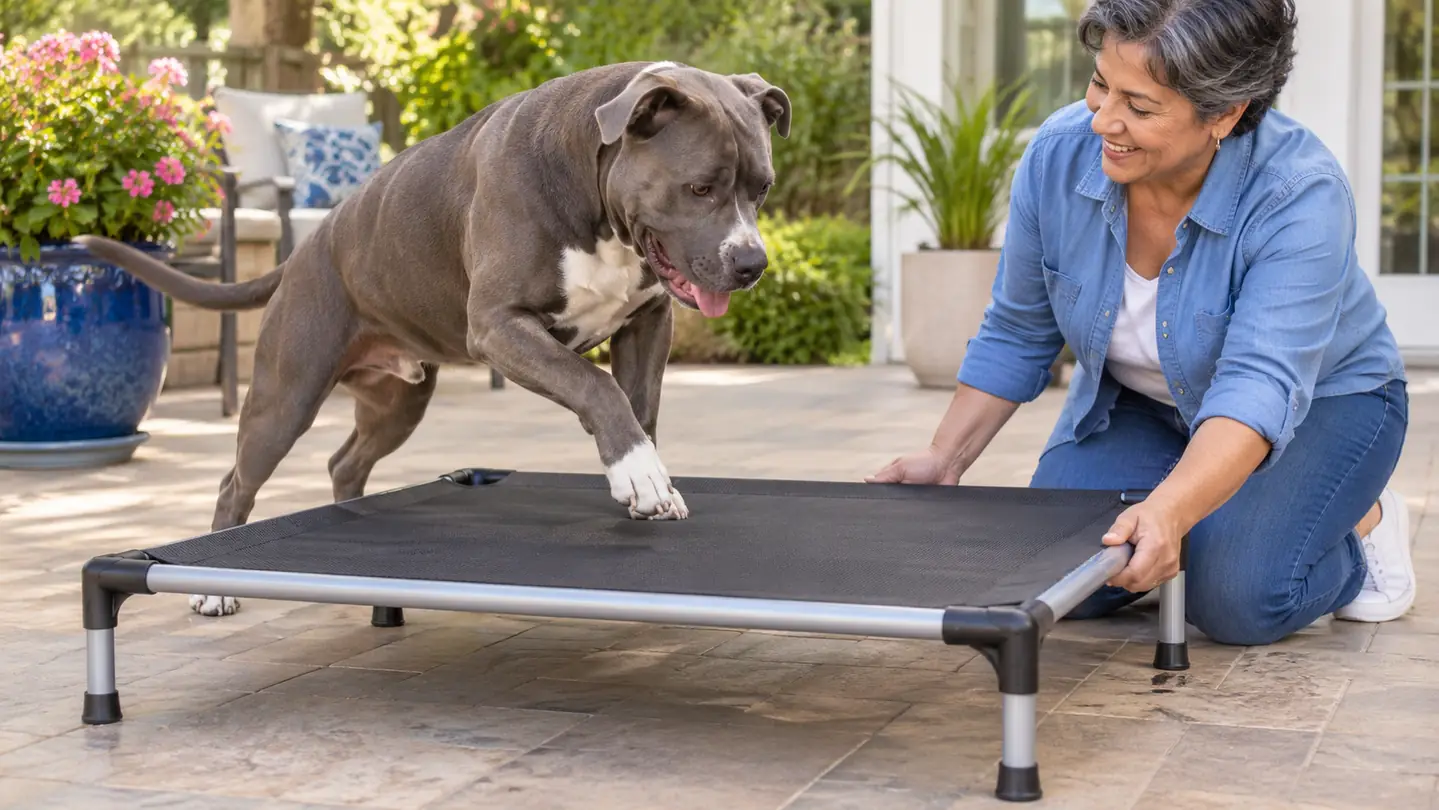
Here is the part I got wrong for a long time. I thought I was shopping for a bed that could take chewing. What I was really shopping for was a bed with nothing worth chewing. Foam and fill are the prize. A dog does not chew a bed out of spite. She chews it because there is a seam, there is stuffing behind the seam, and pulling on it produces a result.
The Veehoo bed does not offer that result. It is a taut panel of fabric stretched on a frame, seven inches off the ground, with no fill and no loose edge to work at. Biscuit sniffed it, walked a circle around it, and eventually lay down. She has never once mouthed it, because there is nothing there that rewards the effort. The listing calls the material chew resistant, and I think that is the honest phrase to use. No bed is chew proof against a dog who has decided to make it a project.
So the question to ask yourself is not how tough the fabric is. It is what your dog does to a bed when she is bored. If the answer is that she chews a hole and pulls the insides out through it, an elevated cot takes the entire activity off the table. If the answer is that she digs and circles and nests before she lies down, watch for a cot with a tight panel, because a loose one gives a digger something to grab and a tight one just annoys her into lying down.
Here is the two minute test I use now. Press a hand flat on the panel and lean. If the fabric gives a lot and the frame rocks with it, a digger will find that give and work at it. Then look for any zipper, seam or flap within reach of a dog's mouth, because a zipper pull is a handle as far as a determined chewer is concerned.
Step 3: Pick the frame before you look at the fabric
Frames fail more often than fabric does, and nobody puts that in the listing photos. A lot of inexpensive cots use thin legs and plastic joints, and a 58 pound dog launching onto one twice a day, every day, is a load that adds up quietly. I wanted metal. The Veehoo frame is aluminum and the whole bed weighs 7.76 pounds, which is light enough for me to drag from the patio to the living room by myself.
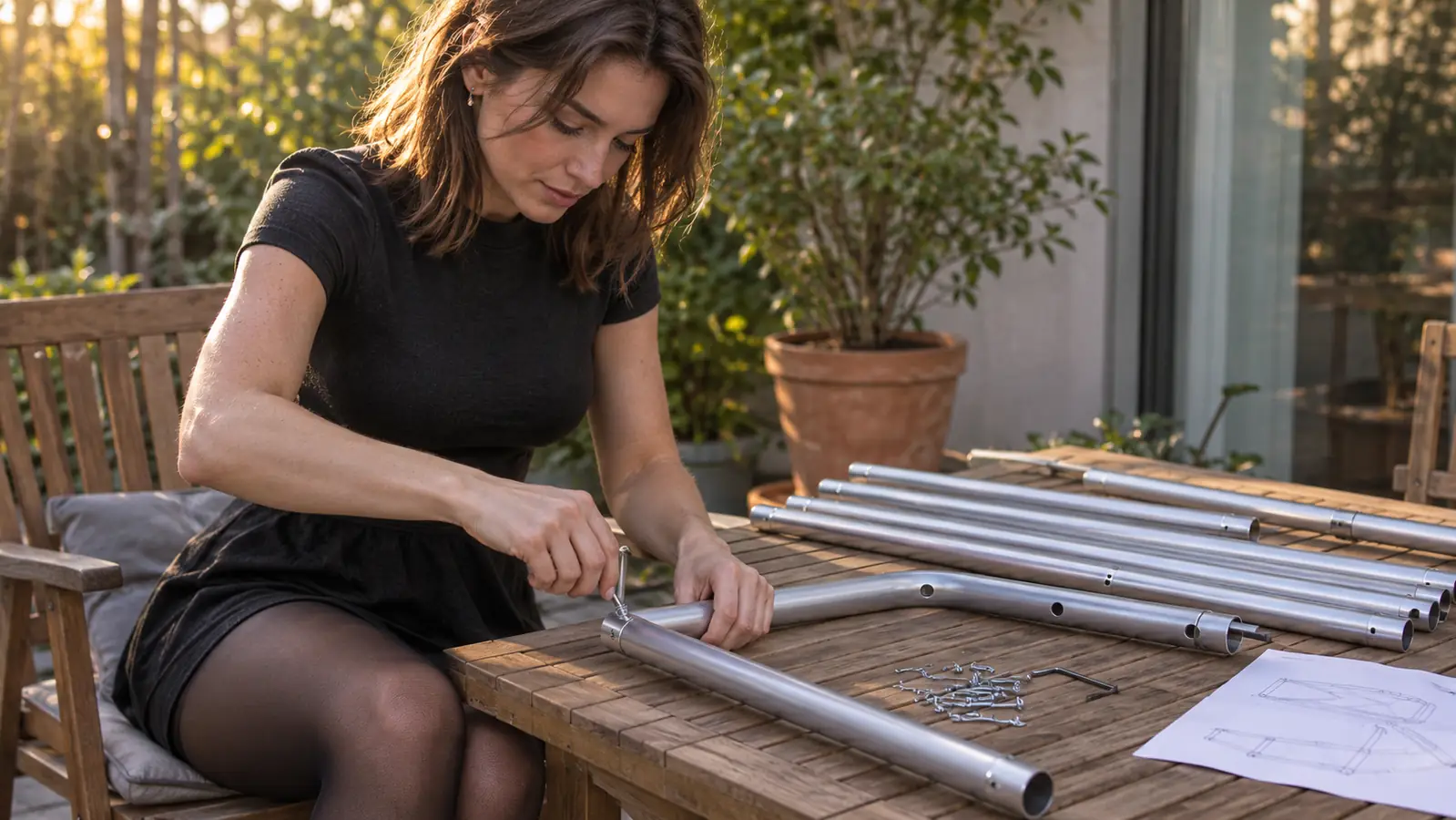
It arrived with screws and a hex tool in the box. I assembled it on the patio in about 20 minutes without reading the directions twice, and I am not a person who is handy. That matters more than it sounds. A bed that takes a fight to put together is a bed that ends up leaning against the garage wall and never gets used.
Then check the corners once it is up. Corners are where the panel attaches and where the frame takes the most stress. Run your hands around each one when the bed arrives, and run your hands around them again a few weeks later once the screws have had a chance to settle. It takes a minute and it tells you things the box never will.
The other thing worth checking is what happens where the legs meet the ground. Plastic caps on metal legs are fine on carpet and poor on concrete, because they crack and the leg sits bare and rusts at the base. Mine has sat on tile and on concrete for 14 months with nothing cracked and nothing rusting. If the bed is going in a garage, start there.
Step 4: Check the height, the footing and the cleaning
Seven inches off the floor sounds like a small detail until you have lived with it. It keeps the dog off cold concrete in January and off hot patio stone in July, and it lets air move underneath her. In an Albuquerque summer that is the difference between a dog who uses the bed and a dog who digs a hole in the garden instead.
The bottom is non skid and the surface is stain resistant. I have hosed the panel down twice, once after a muddy spring and once after a plate of beans came off the counter at the wrong moment, and it dried in the sun without a mark. The non skid bottom earns its keep on patio tile, because Biscuit steps on hard and the bed stays put.
Cleaning is where an elevated bed earns its place in a house with a dog who has skin trouble. Biscuit gets a bath every three weeks, and before this bed I was washing foam covers and waiting two days for the inside to dry. Here there is no cover and no inside. I wipe the panel with a wet cloth or hose it on the patio, and it dries in an hour in the New Mexico sun.
One honest note about the cooling claim in the listing. A raised cot is cooler than foam because air moves under it, but it is not a cooling system and it will not fix a dog who runs hot. Biscuit still finds the bathroom tile on the worst afternoons of the year. I would call it a comfortable place to land. That is my read after 14 months, and it is the sort of plain sentence I wish more listings would write.
Step 5: Give it a week before you call it a failure
Biscuit did not use the bed for the first week. She walked around it, sniffed the legs, and lay on the concrete right next to it. I did not lift her onto it and I did not stand there coaxing. I put it where she already chose to lie down and then I left it alone.
By the end of that week she was on it every morning. Now it is the first place she goes after a walk. A new bed is a new object in a dog's territory, and the territory rules take a few days to update. Give it a week before you decide the money was wasted, especially if your dog is the suspicious type the way mine is.
While you wait, do the upkeep. I go around the screws once a month with the hex tool that came in the box. I check the panel for wear the same way I check her KONG Extreme, by running my hands over it and looking for anything that has changed since the last time I looked. Fourteen months in, there are no tooth marks in the panel and no bends in the frame.
Fourteen months, one aluminum frame, and not a single tooth mark in the panel. That is the whole review.
What Else Helps
A bed is not a cure for a dog who chews. It is one less thing to destroy. If you take away the foam bed and give her nothing in its place, she will move on to the couch cushions, and you will have traded a cheap problem for an expensive one.
For Biscuit the chewing goes into a KONG Extreme, size Large, stuffed with kibble and a little xylitol free peanut butter and frozen overnight. She gets it in the afternoon and it buys me an hour of quiet. That is the chewing job. The bed is the rest job. Do not ask one product to do the other's work, because it will not and then you will blame the wrong thing.
Placement is its own small decision. I keep the bed against a wall in the living room corner in winter, because Biscuit likes her back covered when she sleeps, and out where she can watch the yard in summer. Moving it takes less than a minute each time and it has made the bed more useful than any feature printed on the box.
The other thing that helped was a real walk before I leave the house. A tired pit bull is far less interested in remodeling the living room. And if your dog is licking her paws raw or scratching herself sore, that is a conversation for your vet, not a shopping problem. I asked ours about Biscuit and got a whole routine back, not a single product, and I would not pretend otherwise.
If your dog has already been through two beds, stop buying the third one the same way
Measure the sprawl, check the frame, and skip anything with fill inside it. The Veehoo cot is 42 by 30 inches, 7 inches off the ground, aluminum frame, no stuffing. Biscuit has had hers 14 months.
Amazon Check Today's Price on Amazon →