
Biscuit starts licking her paws in the back of the RAV4 before we are out of the park parking lot. Not a quick lick. The slow, grinding kind that keeps up until the fur between her toes is wet and matted and I have to reach back and put a hand on her shoulder to stop it. She is a 6 year old blue-nose pit bull, 58 pounds, with a head like a cinder block and skin that hates the dry Albuquerque air. Every spring the scratching starts and every spring I go through the same list of questions. What did she eat. What did I change. And is this a bath problem or a vet problem.
I am not a groomer. I am 56, retired from a school office, and what I have is a bathtub, a handheld sprayer and a rubber mat. For about 18 months now I have bathed Biscuit with earthbath Oatmeal and Aloe shampoo, one bath every three weeks, and it is the only thing in that bathroom that has made a real difference to her skin. It is not a cure and I will not pretend it is. But the routine below is what I actually do, start to finish, with one strong dog and no help, and it is what I would hand to another pit bull owner who is tired of watching their dog chew at her own feet.
The one bottle that stays under my bathroom sink
earthbath Oatmeal and Aloe is the shampoo I have used on Biscuit every three weeks for a year and a half. Colloidal oatmeal and aloe vera, soap free, pH balanced, with a vanilla and almond scent that does not knock you over in a small bathroom. If you are starting from nothing, start here.
Amazon Check Today's Price on Amazon →Step 1: Get Everything Within Reach Before the Water Goes On
You get one hand. That is the part nobody tells you. Once a 58 pound dog is in the tub and has decided she would rather be somewhere else, one hand is on her and one hand is free, and if the bottle is on the far side of the bathroom you will spend the next ten minutes chasing a wet pit bull around a small room with a bottle in your teeth. I learned that the hard way, twice, and the second time I said a word my grandson should not repeat.
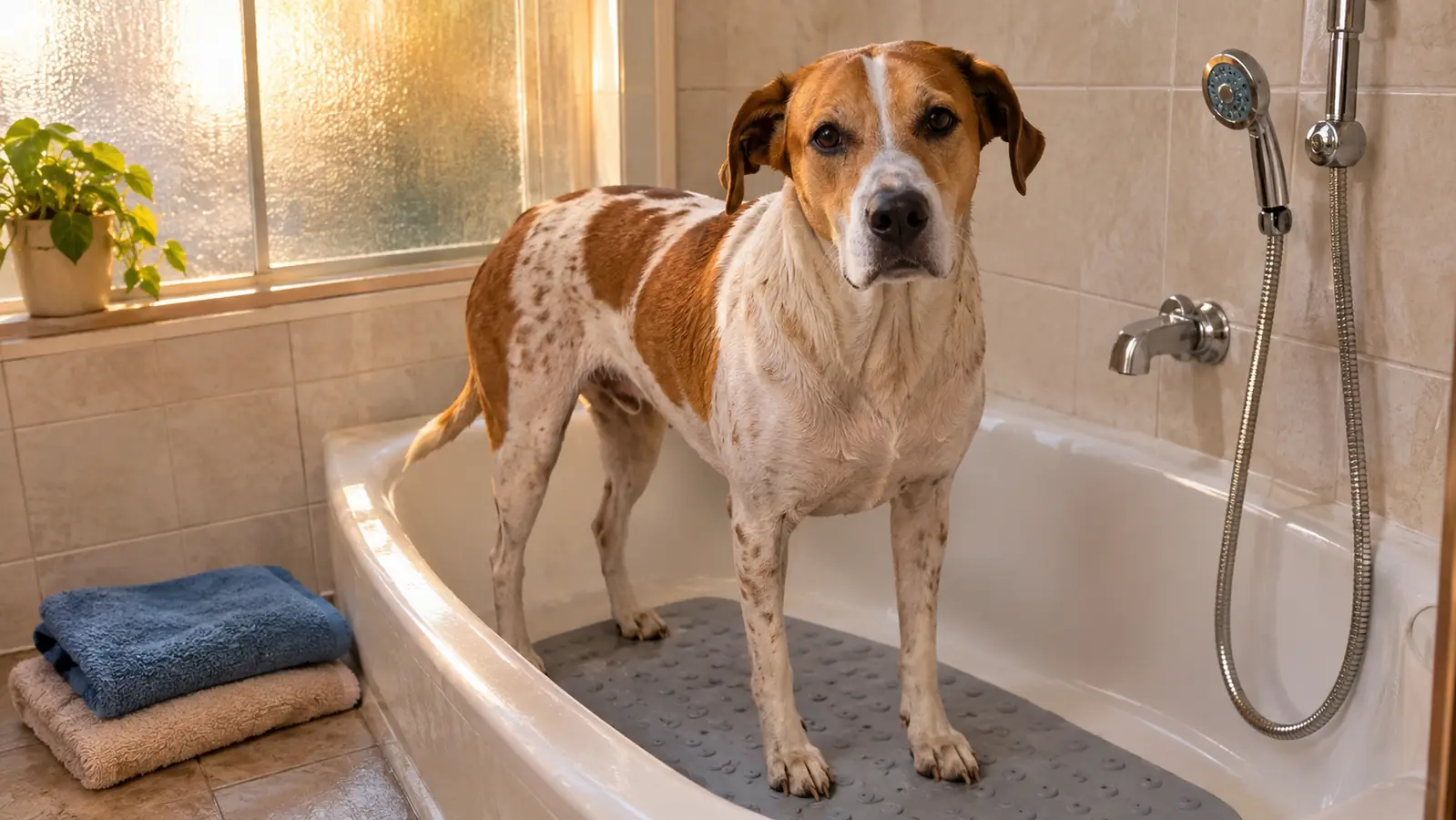
So before the water goes on, everything comes within reach of the tub. The bottle. A plastic cup. Two towels flat on the floor, not one, because one is never enough. The rubber mat already stuck down on the bottom of the tub. The handheld sprayer pulled off its cradle and tested on the inside of my wrist until the temperature is warm and boring. The bathroom door closed, because a wet dog who gets that door open will find the one carpeted room in the house and lie down in it.
The mat is not fussiness. A pit bull's feet on a wet tub floor slide, and a sliding dog panics, and a panicking dog does not care that you are 56 with a shoulder that clicks. Biscuit stands still on the mat. Without it she braces all four legs and shakes and we are both soaked before the shampoo is even open. That mat cost less than the towels and it is the reason this whole routine works.
Step 2: Wet Her Down All the Way to the Skin
A pit bull coat is short and it lies flat, which fools you into thinking it wets fast. Water beads on the top and runs off while the skin underneath is still dry. Dry skin means the shampoo has nothing to work against, so this part is not a formality. It is half the bath.
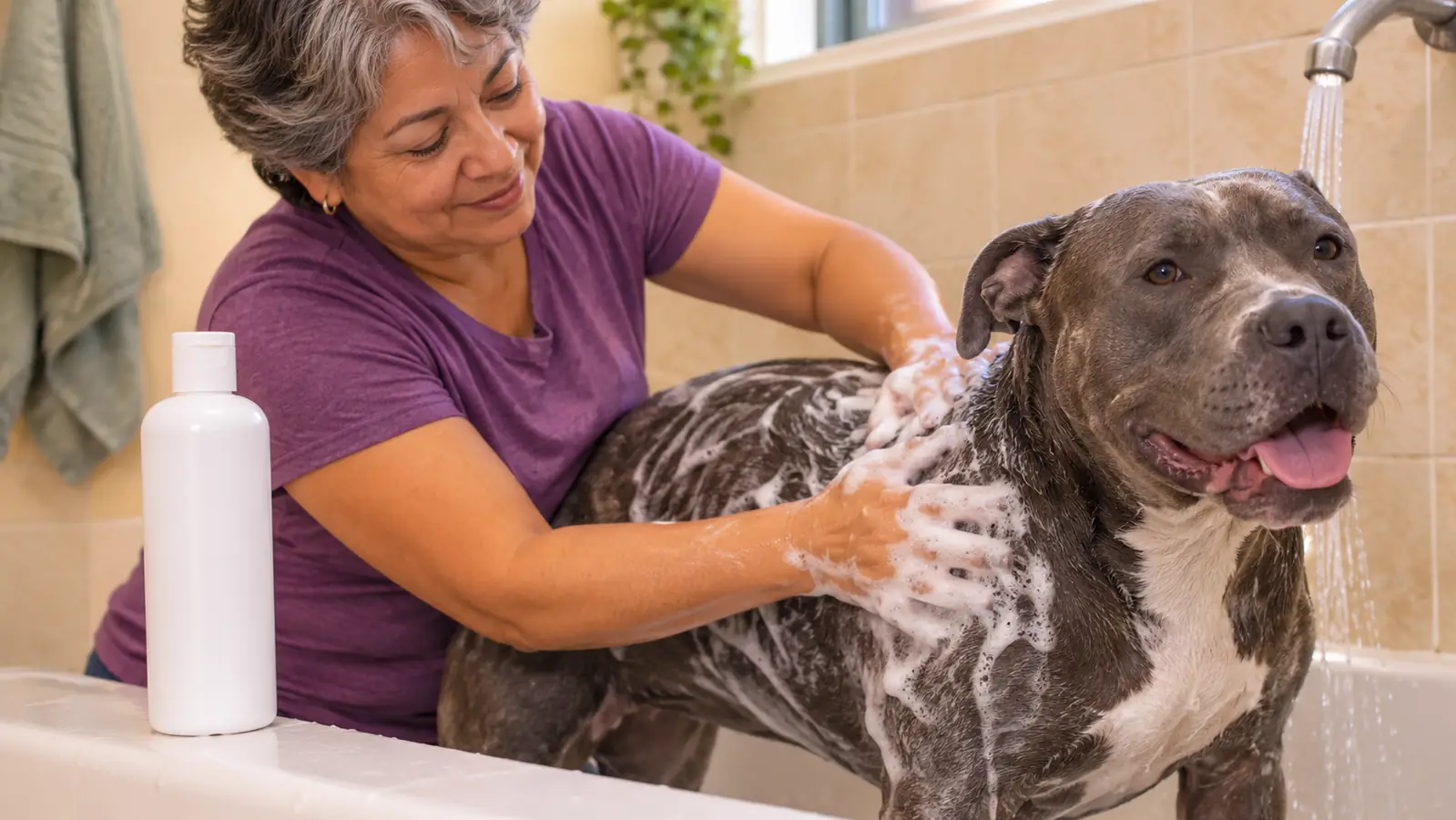
I wet her for a full two or three minutes. Sprayer held low, at the shoulder and ribs, never up at her head. I part the coat with my free hand and run the sprayer underneath, down the back, along both sides, under the belly, and around the back legs where the hair is thin enough that you can see the skin. The cup is for her chest and the front of her neck, poured slow so it does not run down into her eyes.
Her head I do last and mostly with a wet washcloth. Biscuit will put up with a lot, but a sprayer in the face ends the entire operation and I am not strong enough to win that argument twice in one day. Warm water, never hot, on a dog whose skin is already angry. If it is too warm for the inside of my wrist it is too warm for her.
Step 3: Work the Shampoo In Where the Itch Actually Lives
I put a small amount of earthbath in my palm and start at her shoulders, working it down and back with my fingers rather than scrubbing in circles. It does not build a big head of foam, which threw me the first time, because there is no soap in it. What it does have is colloidal oatmeal and aloe vera, plus olive oil and almond in the blend, and it is pH balanced for a dog's skin rather than mine.
The bottle is the 16 ounce size with the vanilla and almond scent. It lives under the bathroom sink and it lasts me a good while at one bath every three weeks, so I am not rationing it and I am not being stingy with the parts of her that need it most.
Where the itch actually lives, on my dog, is not the middle of her back. It is the armpits, the groin, between every toe, the base of the tail, and the strip under her collar where sweat and dust collect. Those spots get the most shampoo and the most time from my fingers. Her face gets a washcloth with a trace of lather on it and nothing more. Nothing goes in her ears, her eyes or her mouth, ever.
Step 4: Let It Sit Five Minutes, Then Rinse Longer Than Feels Right
This is the step people skip, and it is the step that matters most on a dog with itchy skin. I set a timer on the counter for five minutes and I sit down on the bath mat and talk to her. She is not thrilled but she is not fighting either, because standing still has become the deal. Five minutes of contact is worth more than any amount of extra scrubbing.
Then I rinse. And then I rinse again. Soap free shampoos do not strip a coat the way a grocery store shampoo does, but what is left behind sits on the skin and it will itch, so the water running off her back legs needs to be clear before I stop. I run my hand down her side and feel for slick spots. If my fingers slide, there is still shampoo there and I keep going.
I rinse her chest and belly twice, because that is where the suds pool when she lies down in the tub. I rinse the armpits and between the toes twice. By the end of it the water has gone from warm to lukewarm and my back is complaining, and that is about right. A fast rinse is the most common reason a dog scratches worse after a bath than before it.
Step 5: Dry Her Off and Watch the Two Days After
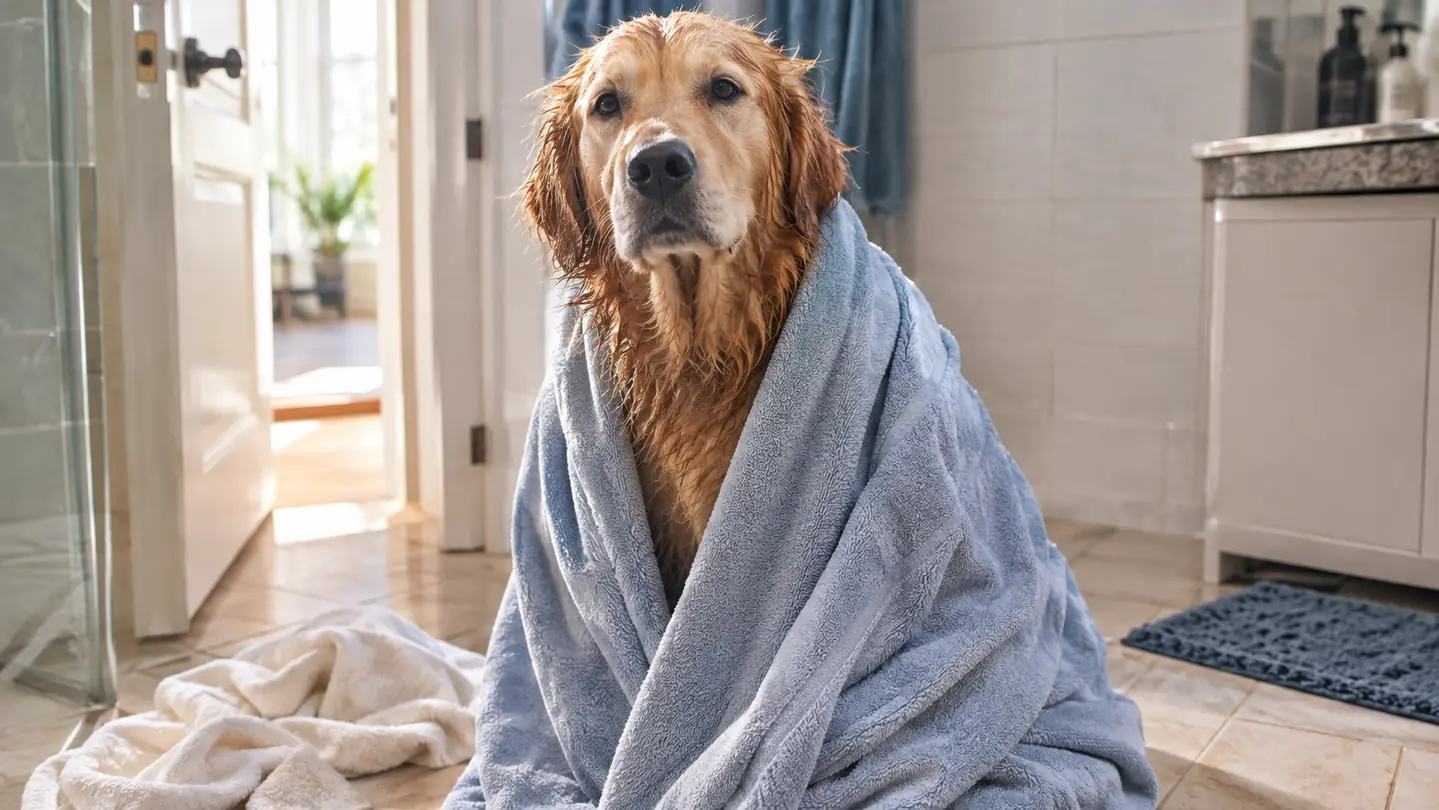
Two towels, and I press rather than rub. Rubbing a short coat just pushes water back into the skin and whips her up at the same time. I press the first towel along her back and sides, then wrap her in the second one and let her stand there for a minute while I wipe down the tub.
No hot hair dryer. I know people do it and I know it looks efficient, but hot air on skin that is already irritated is the wrong move, and the noise alone would cost me her trust for a week. In warm weather she goes out to the patio to finish drying. In winter she stays inside on the tile until she is dry, and I put a towel down on the floor in front of the door so she has somewhere to flop while she does her laps around the living room.
Then comes the honest part. The first bath, I did not see much of anything. The second bath, less chewing at her feet in the evenings. By the third I believed it, and that is what this has been for 18 months now. Once every three weeks, less scratching, calmer evenings. It soothes her skin. It does not explain why her skin is irritated in the first place, and if your dog has red patches, open spots, a smell, or is chewing herself raw, that is a call to your vet and not a shampoo problem.
What Else Helps
The bath is one piece. The daily piece in my house is a lamb flavored allergy chew that I give Biscuit with breakfast, dose by the label for her weight, for about 10 months now, started after a conversation with our vet. I noticed less paw licking at around six weeks. Not overnight, and it never went away completely. I am not going to tell you it treats anything, because I am not a vet and it does not.
The other piece is where she lies down. Two foam beds died before I bought an elevated bed with an aluminum frame, 42 by 30 inches, and that one has survived 14 months with no chew damage. It sits on the covered patio in the warm months and in the living room corner in winter, so she is off hot concrete in July and off cold tile in January. A dog with itchy skin who spends the day on warm cement is going to lick, and no shampoo fixes that.
Two small things that cost nothing. I wash her bedding on the same day I bathe her, so she is not lying down on whatever was making her itchy in the first place. And I keep a frozen stuffed rubber toy for the ten minutes right after the bath, while she is still damp and feeling put out. It keeps her from rolling on the carpet and it keeps her busy while I clean the tub. That is all I have, and most of it I learned the hard way.
It was the second bath before I noticed anything and the third before I believed it. Anyone who tells you the first bath fixed their dog is selling something.
If your pit bull is chewing at her feet tonight, start with the bath
One bottle, one rubber mat, five minutes of lather and a long rinse. That is the whole routine I use on Biscuit every three weeks, and it is the cheapest thing I have tried. Check with your vet about the skin itself, then start here on bath day.
Amazon Check Today's Price on Amazon →